
Dow Jones Indexes, a leading global index provider, has removed scandal-hit Satyam Computer from its 'Dow Jones India Titans 30 Index' and replaced it by Axis Bank.

The 50-50 partnership would bring together BSE's closely watched India index suite, which includes the Sensex, with S&P Dow Jones Indices' 115 years of experience in publishing transparent and independent global benchmarks.

Indian benchmark indices, Sensex and Nifty, rebounded in early trade after two days of decline, driven by positive global market trends and strong buying in auto stocks. This recovery follows a robust performance in US markets and a rally in Asian markets, particularly Japan's Nikkei, fueled by AI-driven technology optimism. Track Sensex, Nifty on July 1.

Rupee-denominated contracts will be traded from 9 am to 5 pm.
Indian benchmark equity indices, Sensex and Nifty, extended their winning streak for a third consecutive day, driven by a rally in IT stocks and global cues suggesting a more accommodative monetary policy after softer-than-expected US jobs data.
Indian benchmark indices Sensex and Nifty surged in early trade, driven by a rally in IT stocks and tempered expectations of US Federal Reserve monetary tightening following softer-than-expected US jobs data. Track Sensex, Nifty on July 3.

Indian benchmark indices, Sensex and Nifty, extended their rally for the fourth consecutive day, driven by a significant drop in crude oil prices and strong performance from IT firms, despite mixed global cues.

Indian stock market benchmarks, Sensex and Nifty, saw gains in early trading, driven by anticipation surrounding the Reserve Bank of India's monetary policy decision, despite mixed global cues and significant FII outflows.

Indian stock market benchmark indices, Sensex and Nifty, experienced declines in early trade due to escalating tensions between the US and Iran, which led to a surge in crude oil prices and weak global equity trends.

Indian benchmark indices Sensex and Nifty experienced a significant slump in early trade, mirroring a sharp decline in global equities and a fresh spike in crude oil prices, exacerbated by simmering tensions in West Asia and a global unwinding of the AI-led rally. Track how sensex, Nifty fared on June 8.

Analysts predict that developments in West Asia, their impact on crude oil prices, and the trading activity of foreign institutional investors (FIIs) will be crucial factors influencing the Indian stock market this week.

The BSE Sensex has been one of the top-performing areas of investment in the past 40 years, consistently delivering double-digit returns in rupee terms, beating assets such as global equities, precious metals, and fixed income.

Indian equity benchmark indices Sensex and Nifty surged significantly in early trade, mirroring a global market rally and a drop in crude oil prices below USD 100 per barrel, driven by renewed hopes of diplomatic engagement between the US and Iran.

Indian equities on Dalal Street saw volatility as global market trends and fresh tariff concerns linked to Donald Trump impacted investor sentiment. Track Sensex, Nifty50 movement and key market drivers for March 30, 2026.

Indian equity benchmarks, Sensex and Nifty, ended lower after a spectacular rally, with the Sensex tumbling 931 points, as renewed tensions in West Asia, particularly the risk to the ceasefire deal after Iran closed the Strait of Hormuz, dampened investor optimism.

Indian stock markets tumbled sharply with the Sensex falling 800 points and nearly 4 lakh crore wiped out in a single session. Here are the 6 key factors, including rupee weakness and global cues, behind the crash.
Benchmark indices Sensex and Nifty tumbled in early trade on Friday after a two-day rally, tracking a weak trend in global peers, as the US-Iran conflict continues to be a key overhang for the markets. Track Sensex, Nifty50 movement and key market drivers for March 27, 2026.
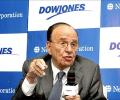
Rupert Murdoch-promoted News Corporation on Monday said it will invest $100-million in the next 12-months to start six regional channels under the Star brand in India.
Media baron Rupert Murdoch plans to invest $100 million within a year to launch 6 regional channels under Star brand in India.
Domestic bourse BSE has approved the acquisition of a 50 per cent stake in index provider Asia Index (AIPL) from equal joint venture partner S&P Dow Jones (SPDJ) Indices for Rs 30 crore. AIPL, the index provider, is responsible for compiling and maintaining the widely followed Sensex, Bankex, and other indices. Passive funds with assets of nearly Rs 2 trillion are benchmarked with indices provided by AIPL.

Indication of a potential US Federal Reserve rate cut may trigger optimism in the domestic equity market, with investors' attention shifting to the looming deadline for additional US tariffs on Indian goods in a holiday-shortened week ahead, analysts said.

The index is more expensive than it was at 2014-end or when it hit a life-time high in January.
IndusInd Bank, Nestle, UltraTech Cement, Mahindra & Mahindra, Power Grid, Asian Paints, Sun Pharma and Tech Mahindra were also among the laggards. Bajaj Finance, Bharti Airtel, ICICI Bank, Adani Ports and HCL Tech were among the gainers.
'If the US stagnates and falls into a recession, the dollar will weaken, oil prices will also dip. This augurs well for India.'
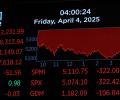
Last Friday's tumble on Wall Street, with the Dow Jones index falling nearly 400 points, is sure to have its repercussions on the already shaky Indian market. With both the benchmark indices, the Bombay Stock Exchange Sensex and the National Stock Exchange Nifty having lost 5 per cent apiece last week, investors are already skittish.

From the Sensex firms, Infosys declined by 3.54 per cent. Power Grid, Eternal, HCL Tech, Tata Consultancy Services, Bharti Airtel, IndusInd Bank, NTPC and HDFC Bank were the major laggards. Sun Pharma, Adani Ports, Bajaj Finance, State Bank of India and Tech Mahindra were the gainers.

The growth premium India enjoyed has largely been lost.
In a major development that will allow Indian investors access to the American market, the National Stock Exchange (NSE) has decided to begin trading in futures contracts of S&P 500 and Dow Jones Industrial Average (DJIA), two of the world's most influential market indices.

The Indian markets have delivered high long-term returns, second only to the US.
The issue of allowing trading in indices such as the Dow Jones and the S&P 500 on the National Stock Exchange (NSE) is being considered by the Reserve Bank of India (RBI).

The Congress-led opposition stepped up its attack on Friday against the government over the Adani row and demanded that there should be a thorough investigation into what they alleged was a 'mega scam' as it involved public money.

Post partnership with S&P, the exchange is looking at launching a slew of international products, too.
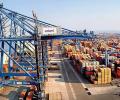
Gautam Adani-owned Adani Ports and Special Economic Zone (APSEZ) will replace IT major Wipro in the 30-share BSE Sensex from June 24, according to an official announcement on Friday. This marks the first inclusion of any Adani Group firm in Sensex. The group has 10 listed firms with a combined market valuation surpassing Rs 17 lakh crore.

Domestic benchmark equity indices may see a positive trading sentiment on Friday thanks to a spectacular rally in world markets after the US President Donald Trump announced to put tariff hikes on hold for 90 days, excluding China from the reprieve. Indian stock markets were closed on Thursday for Shri Mahavir Jayanti. Trump has declared a three-month pause on reciprocal tariffs on non-retaliating countries marking a rather unexpected U-turn after record high levies he imposed led to global stock market meltdown.


Proceedings in both Lok Sabha and Rajya Sabha were disrupted as Opposition members raised slogans demanding a discussion and a Joint Parliamentary Committee (JPC) probe into the fraud-allegation-triggered rout.

Indian passenger vehicles market registered record wholesales of 43 lakh units in 2024, with companies like market leader Maruti Suzuki, Hyundai, Tata Motors, Toyota Kirloskar Motor, and Kia posting their best-ever annual domestic sales. The continued growth of SUVs, along with rural markets playing a key role in driving up car sales, helped the industry better the previous best of nearly 41.1 lakh units posted in 2023.
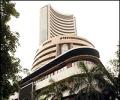
The National Stock Exchange listed the Dow Jones Industrial and S&P 500 on its platform last week.

According to Dow Jones VentureSource, a VC industry tracking firm, investments grew in almost every venture hub globally in the April-June quarter, a sign of recovery in the global economy.
